Phage display campaigns become far more demanding when the target is difficult to validate with conventional workflows. Creative Biolabs offers a dedicated solution integrating tailored antigen preparation, library screening logic, and counter-selection to help you move from a difficult concept to actionable candidates.
Explore Target Modules


Within our Phage Display Applications portfolio, Creative Biolabs offers a dedicated challenging target discovery solution designed for high-complexity research settings. This service integrates tailored antigen preparation, library screening logic, counter-selection design, and downstream characterization to help researchers move from difficult target concept to actionable binder candidates and validation data.
Many important research targets do not behave well in standard discovery formats. G protein-coupled receptors require native-like presentation. Ion channels and transporters often depend on membrane context and conformation-sensitive epitopes. Post-translationally modified targets demand exquisite discrimination between modified and unmodified states. Intracellular proteins may require specialized validation routes after initial binder identification. Anti-idiotype projects depend on tight specificity against defined paratopes, while virology programs often need breadth, escape awareness, and function-oriented screening design.

Fig.1 Customized phage display discovery workflows tailored for complex and challenging targets.
Phage display is particularly well-suited to these problems because the screening strategy can be adapted to the target rather than forcing the target into a fixed discovery template. Creative Biolabs supports this flexibility through multiple target presentation formats, customized panning conditions, and hit triage workflows aligned with your research objective. Whether your study starts from purified antigen, engineered cells, membrane preparations, viral proteins, or a difficult epitope state, our team can help convert those materials into a practical discovery path.
If your program already has a target hypothesis, a preferred binder format, or a defined assay cascade, we can design the campaign around those constraints. If the biology is still evolving, we can also help build a staged discovery plan that reduces early risk and improves decision quality before larger investment.
If your target is membrane-bound, heavily modified, poorly immunogenic, conformationally sensitive, or biologically restricted, share the target background, available materials, and preferred readout with our team. We can help define a practical phage display route for your study.
Consult Our ExpertsCreative Biolabs has extensive experience in adapting phage display workflows to targets that are unstable, low abundance, conformationally dynamic, or structurally complex. Rather than using one generic screening route, we align antigen preparation, depletion strategy, stringency escalation, and validation design with the specific target class.
Some projects require strict selectivity against close homologs. Others need state-specific binders, broad viral recognition, PTM discrimination, or intracellular validation compatibility. Our workflow design supports these different priorities through project-specific screening logic and data interpretation.
Discovery alone is rarely enough for difficult targets. We therefore emphasize usable outputs, including hit ranking, sequence information, preliminary binding data, and next-step recommendations for research validation. This makes it easier to decide which candidates should move forward into reformatting, functional testing, mechanistic study, or assay development.

GPCR discovery projects often fail when receptor conformation is not preserved during antigen preparation. Our service supports receptor-focused campaigns using target formats compatible with native-like presentation and downstream functional assessment. This route is suitable for researchers seeking binders with defined receptor engagement profiles, conformational preference, or early functional relevance.

Ion channels and transporters create additional discovery barriers because extracellular accessibility, conformational transitions, and membrane dependence all influence binder recovery. Our service is designed to support selective screening against these structurally challenging target classes in research settings where standard soluble antigen workflows are insufficient.

Projects targeting phosphorylation, acetylation, methylation, glycosylation, ubiquitination, or related PTM states require binders that distinguish subtle chemical differences with high precision. Our service focuses on screening logic that prioritizes modification-state selectivity while reducing enrichment of sequence-similar off-target binders.

When the research objective extends beyond extracellular binding into intracellular pathway interrogation, candidate selection should consider downstream expression and validation needs from the start. Our service supports binder generation for intracellular research applications and target engagement studies.

Anti-idiotype programs require high specificity for the variable region of a reference antibody and must often be aligned with assay development requirements. Our service supports research-stage anti-idiotype discovery with attention to specificity, pairing strategy, and downstream assay compatibility.

Virology-focused discovery programs often need breadth across strains, conserved epitope recognition, or function-oriented screening cascades. Our service helps researchers identify candidates suitable for comparative viral binding and neutralization-oriented research workflows.
Different difficult targets call for different discovery routes. In practice, the success of a campaign often depends less on library size alone than on how well the screening context matches the biological reality of the target.
This option is useful when purified ectodomains, domains, peptides, modified antigens, or engineered target constructs can preserve the epitope of interest. It supports controlled screening pressure, well-defined counter-selection, and efficient early triage.
This route is valuable when native membrane context matters, especially for GPCRs, ion channels, transporters, and other conformationally sensitive surface proteins. Cell-based panning can improve the relevance of target presentation and help enrich candidates that recognize accessible native states.
Some challenging targets require a hybrid path rather than a single screening format. Send us your target class, available antigen format, and desired endpoint, and we will recommend a project-matched discovery strategy.
Request Project AssessmentWe review target class, biological question, available materials, desired binder profile, and downstream research plan to define risks and routes.
Target presentation format, library choice, depletion logic, and panning conditions are selected according to constraints.
Biopanning is conducted with customized controls and tuned stringency to balance recovery and selectivity.
Recovered candidates are evaluated through sequencing, uniqueness analysis, enrichment review, and triage criteria.
Selected candidates move into binding confirmation, assay pairing, or follow-up studies depending on the module.
Researchers commonly provide one or more of the following. If materials are limited, we can help evaluate feasible formats.
Purified proteins, domains, peptides, or modified antigens
Target-expressing cells, membrane preparations, or reference reagents
Sequence information, target family background, or competitor molecules
Deliverables vary by module, but the goal is always to provide usable research outputs rather than isolated raw results.
Screened and prioritized candidate binders
Sequence data and clone-level summary
Preliminary binding or screening performance data
Target-class-specific interpretation and recommended next steps
Published work suggests that challenging membrane targets may benefit from screening strategies that combine multiple target presentation formats, sequence-based enrichment analysis, and an early functional screening step.
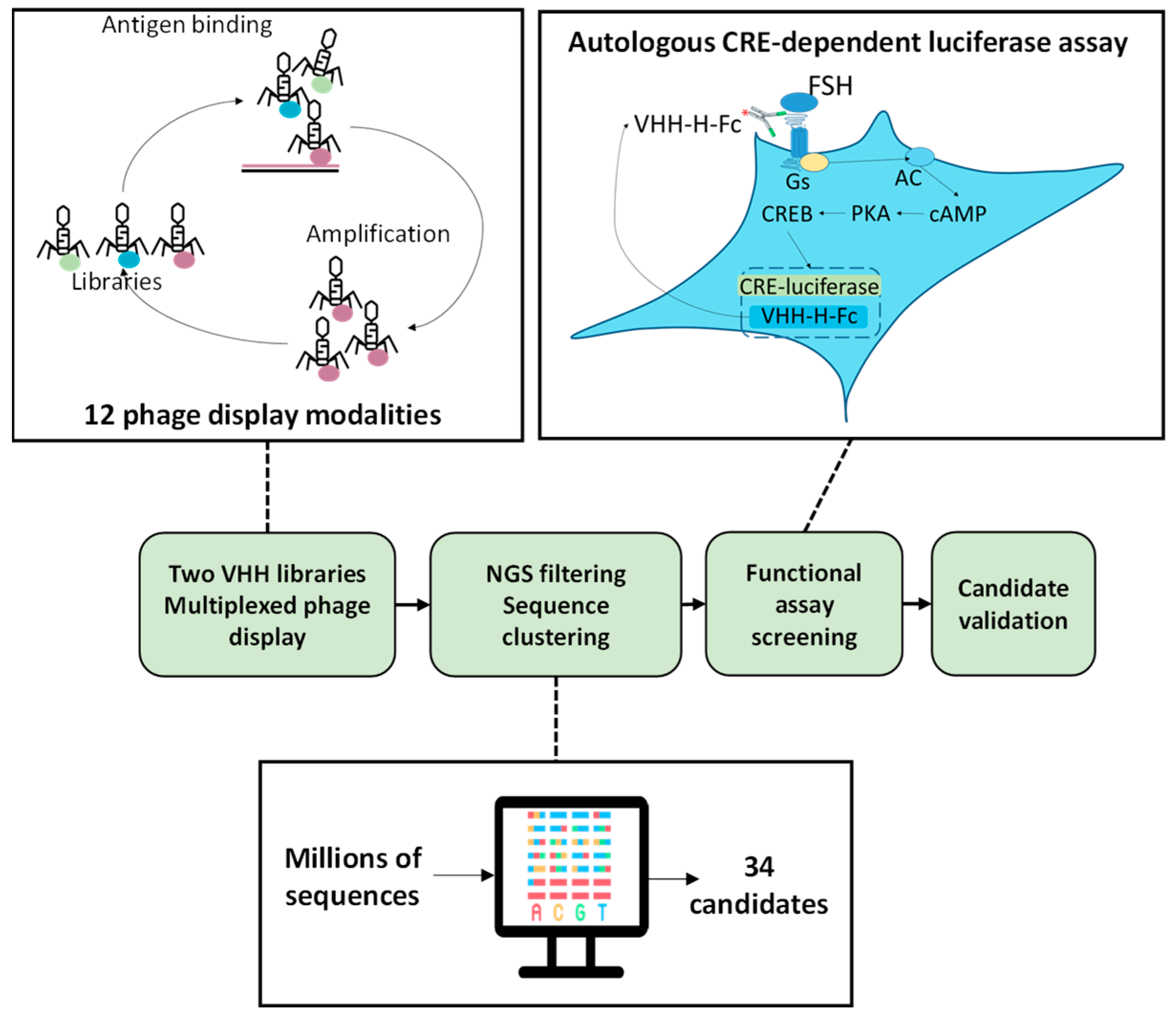
Fig.2 Multiplexed phage display workflow for GPCR discovery.1
In a study, Zehnaker and colleagues investigated the follicle-stimulating hormone receptor, a GPCR that is difficult to address by antibody discovery, using a multiplexed phage display workflow that incorporated multiple FSHR presentation formats, next-generation sequencing, and a CRE-dependent functional assay.
In this study, the authors identified 34 enriched candidate clusters, and 23 candidates showed positive or negative modulation in the primary functional screen, supporting the value of this integrated workflow for FSHR-focused binder discovery.
For researchers working on GPCR-related discovery, it provides a concrete example of how diversified target presentation and early functional readouts can be integrated within one research workflow.
If you are planning a GPCR, transporter, PTM-selective, intracellular, anti-idiotype, or virology-focused discovery campaign, Creative Biolabs can help translate that concept into a screening and validation workflow tailored for research use.
Contact Us to Get StartedPlease kindly note that our services can only be used to support research purposes (Not for clinical use).

Creative Biolabs is a globally recognized phage company. Creative Biolabs is committed to providing researchers with the most reliable service and the most competitive price.

